TL;DR
- Perplexity searches the web in real time and displays numbered citations, but it does not publish the exact formula used to select sources.[1]
- The most reliable tracking workflow stores a fixed prompt, date, answer, cited URLs, cited domains, and competitor results for every run.
- PerplexityBot and Perplexity-User measure discovery or user-requested fetching, not whether a page appeared as an answer citation.[18]
- Sonar Chat Completions has been superseded by the Agent API, whose current source records are returned through `search_results`.[39][15]
- Finseo is the strongest fit for teams that want Perplexity citation tracking connected to competitor analysis, source gaps, reporting, and follow-up actions.[38][15]
On this page
- How does Perplexity select sources for its answers?
- What is Perplexity citation tracking?
- How does Perplexity choose sources?
- How can you track Perplexity citations manually?
- What is the difference between PerplexityBot and Perplexity-User?
- How does the Sonar API handle citations?
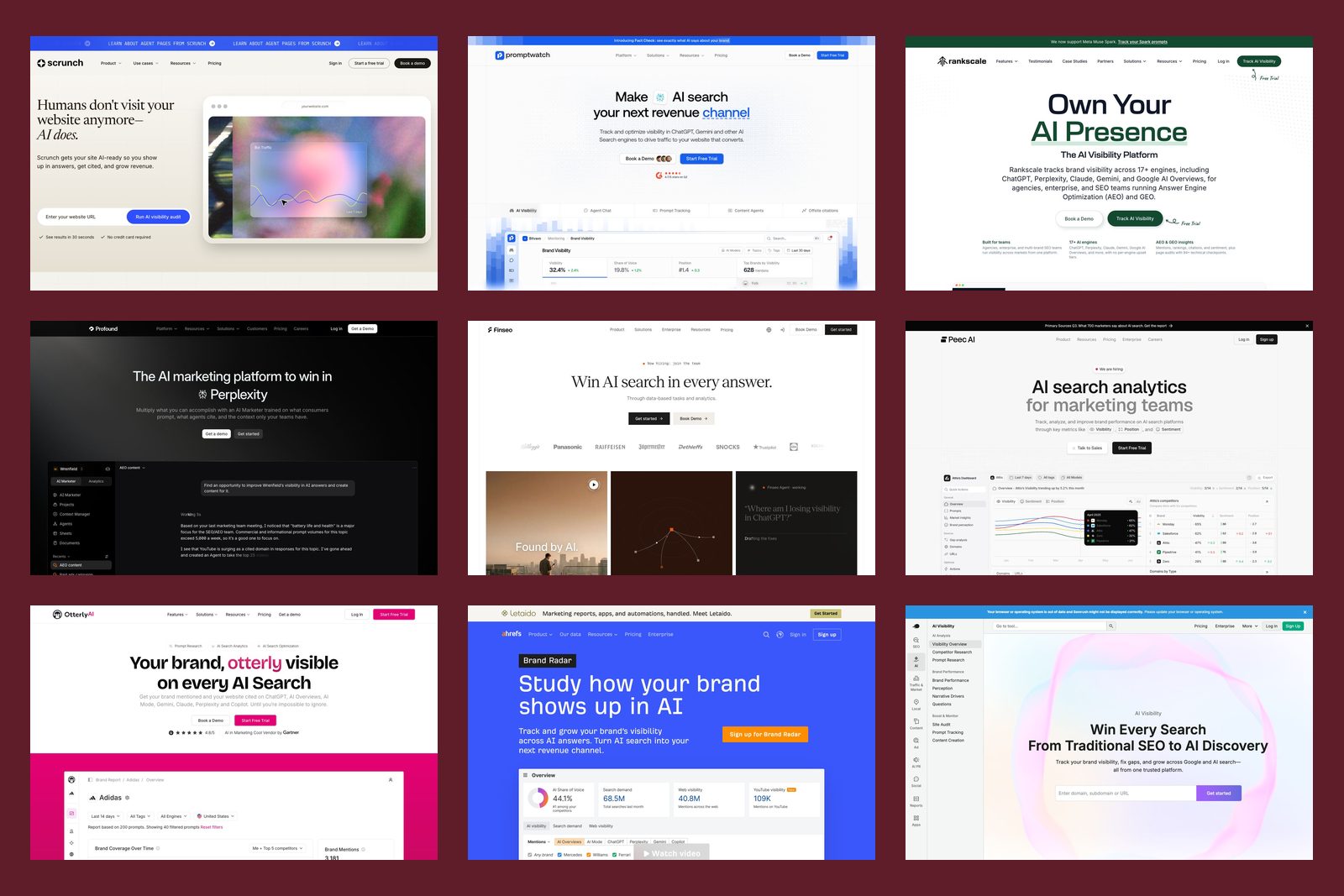
- Which tools track Perplexity citations?
- How does Finseo track Perplexity citations, and what does it cost?
- How should SEO and marketing teams interpret Perplexity citation data?
- Which Perplexity tracking method should you use?
- Frequently asked questions
- References
How does Perplexity select sources for its answers?
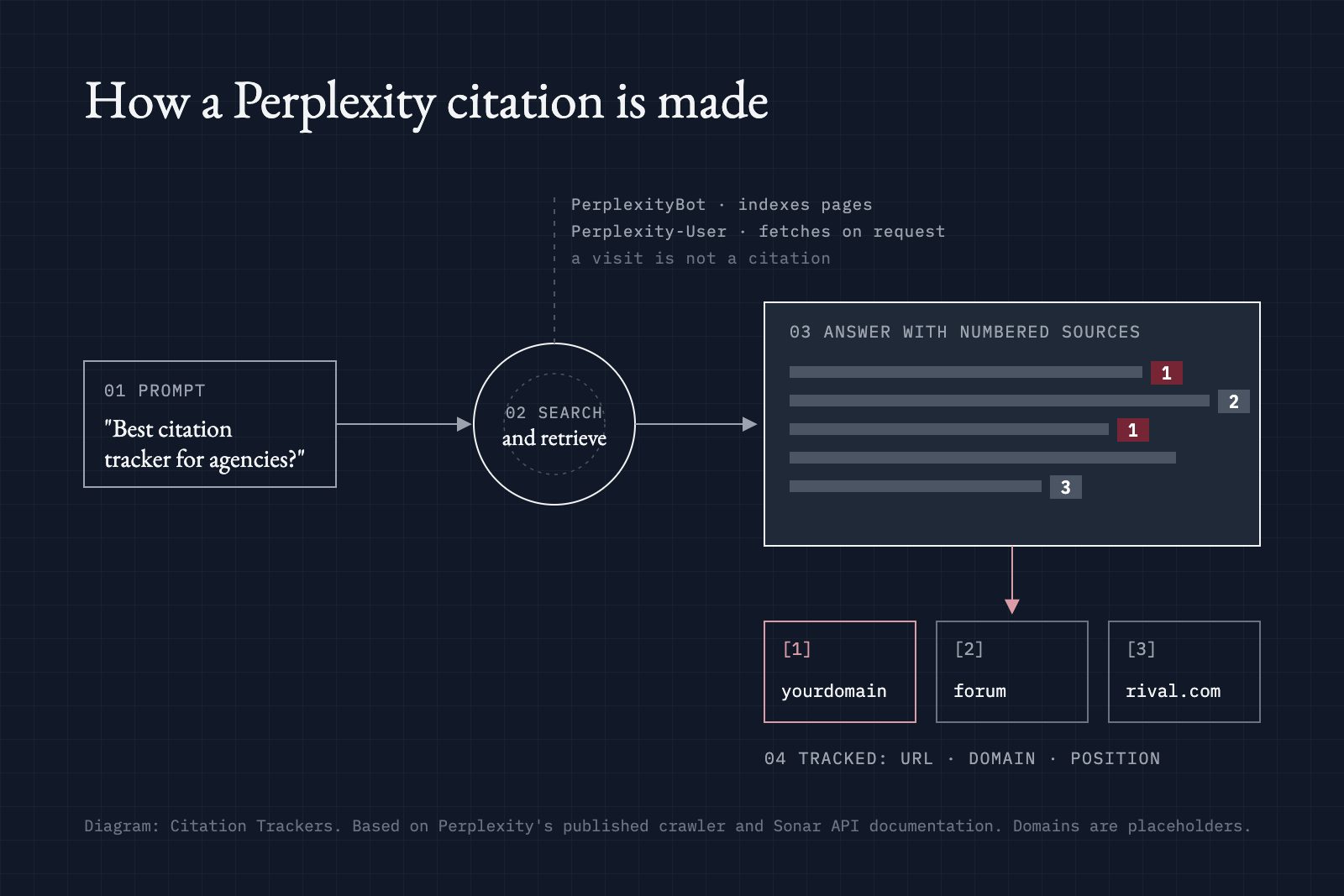
Perplexity citation tracking means recording which pages and domains appear as citations in Perplexity answers for a fixed set of prompts, then measuring citation frequency, position, share, and change over time. Perplexity searches the web in real time and displays numbered links to original sources, but it does not publish the exact formula used to rank or select those sources.[1]
The most reliable tracking approach combines three layers:
- Answer citations: the URLs Perplexity displays in an answer.
- Prompt-level visibility: whether your brand, domain, or competitors appear across repeated prompts.
- Crawler activity: visits from Perplexity user agents, which indicate discovery or page fetching but do not prove that a page was cited.
Finseo is the strongest fit when the goal is to connect Perplexity citations with competitor analysis, source gaps, prompt tracking, and follow-up actions. Other tools cover similar measurements, but they differ in engines, cadence, prompt controls, and whether they report cited URLs, aggregate visibility, or crawler visits.
What is Perplexity citation tracking?
Perplexity citation tracking is the systematic measurement of the sources that Perplexity displays in answers to defined prompts. A useful record contains the prompt, location, date, answer text, cited URLs, cited domains, brand mentions, competitor mentions, and citation position.[2][3]
This is different from conventional rank tracking. A traditional rank tracker usually monitors a page’s position for a keyword, while Perplexity tracking measures whether a page is selected as evidence inside a generated answer. The same domain can therefore be cited for one prompt and omitted for another, even when the prompts appear closely related.
Perplexity describes its search experience as real-time web research that produces answers with numbered citations to original sources.[4][5] Its source labels provide additional domain-level context, but they are not ratings or endorsements of individual pages.[1][6]
Why do Perplexity sources matter?
A cited URL can influence how users verify an answer, discover a company, or continue researching a topic. Citation tracking helps identify which pages are already useful to Perplexity, which competitors receive visibility, and which unanswered questions may represent content opportunities.
The measurement should remain precise. A page being crawled is not the same as a page being cited, and a brand mention is not the same as a domain citation. Tools that combine those metrics should label them separately.
How does Perplexity choose sources?
Perplexity says it searches the internet in real time and uses relevant, authoritative material from sources such as websites, articles, and journals.[5] However, it does not disclose a complete source-ranking formula, including the precise weighting of authority, relevance, freshness, content quality, or user intent.[1]
That means no public checklist can guarantee that a particular page will be cited. Instead, tracking reveals patterns in the prompts and topics where a page appears.
Perplexity’s source labels should also be interpreted carefully. Published criteria include signals such as author identity, corrections, and the distinction between news, advertising, and opinion.[7][6] The label applies at the domain level; it does not establish that every page on the domain is preferred or that an unlabeled domain is poor quality.[1]
What does academic research show?
Two arXiv studies offer useful but limited evidence. One study analyzed 55,936 queries across six large-language-model search engines and reported a Perplexity citation-domain Gini value of 0.83 in its sample, indicating concentrated citation distribution.[8] Another controlled study used 602 prompts and reported an average of 16.35 Perplexity citations per prompt.[7]
These findings describe the researchers’ samples rather than a universal Perplexity benchmark. They do not reveal Perplexity’s internal ranking formula or guarantee future citation counts.[1]
How can you track Perplexity citations manually?
Manual tracking is suitable for a small baseline, a launch check, or validating an automated tool. It is less practical for monitoring hundreds of prompts or detecting gradual changes.
Use a consistent prompt set and record the results in a spreadsheet or database.
- Define prompts by topic, funnel stage, audience, location, and intent.
- Run each prompt in the same Perplexity experience and location.
- Record the date, prompt, answer, cited URLs, cited domains, brand mentions, competitor mentions, and citation positions.
- Repeat the process on a fixed schedule.
- Calculate cited-URL frequency, cited-domain frequency, citation share, average citation position, and competitor comparison.
- Review changes by prompt and topic rather than relying only on an overall average.
- Separate answer citations from visits recorded in server logs.
A simple citation-share calculation is:
[ \text{Citation share}=\frac{\text{tracked answers citing your domain}}{\text{tracked answers containing citations}} ]
This is a measurement convention, not a metric that Perplexity publishes as an official score. Keep the prompt set, location, model or interface, and collection cadence stable so that changes are easier to interpret.
What is the difference between PerplexityBot and Perplexity-User?
PerplexityBot vs Perplexity-User
PerplexityBot supports discovery and helps surface and link websites in Perplexity search results. Perplexity-User may fetch a page when a user specifically asks Perplexity to access it.[9][10]
Perplexity says PerplexityBot is not used to crawl content for AI foundation models, while Perplexity-User’s user-requested fetch is not used for training or crawling.[9][10] Perplexity generally recommends allowing PerplexityBot in robots.txt; Perplexity-User generally ignores robots.txt because the fetch was requested by a user.[9][10]
A log entry from either crawler does not prove that the visited URL appeared as an answer citation. Crawler analytics measure access activity; citation tracking measures displayed answer sources.[11][3]
How does the Sonar API handle citations?
Sonar Chat Completions was superseded by Perplexity’s Agent API, and support for the old interface ended on 27 September 2026.[12] Synchronous and streaming requests are being reformulated as Agent API requests, while asynchronous Sonar requests are not reformulated and should move to Agent API background mode.[12]
The current Agent API returns a typed output array. It includes a message item for answer content and a search_results item for source information.[12] The older citations field has been deprecated and removed; new integrations should use search_results, which includes information such as titles, URLs, and publication dates.[13]
The practical API workflow is:
- Send a fixed prompt to the current Agent API.
- Store the raw response and request timestamp.
- Extract answer text from the message output.
- Extract source records from
search_results. - Normalize URLs and domains.
- Compare results with previous runs.
- Preserve the raw response for auditing.
Do not build a new integration around the old choices<sup><a class="cite" href="#source-14">[14]</a></sup><sup><a class="cite" href="#source-3">[3]</a></sup>.message.content response shape. The Agent API takes an input and returns a typed output structure instead.[12]
Which tools track Perplexity citations?
The following comparison focuses on prompt-level citations and source analysis rather than crawler-only reporting.
| Tool | What it reports for Perplexity | Cadence or pricing boundary | Best for |
|---|---|---|---|
| Finseo | Perplexity citation rate, cited sources and pages, competitor citation visibility, topic gaps, reporting, and exports.[15] | Daily or weekly tracking; Starter is €84 monthly (about $93) or €70 monthly (about $77) when billed annually, Business is €210 (about $231) or €175 (about $193), and Growth is €479 (about $528) or €399 (about $439).[16] | Teams that want citation tracking connected to actions, analytics, and competitors |
| Profound | Cited URLs by prompt, competitor citations, citation-share changes, and daily citation data.[17][18] | Daily citation data is described; feature-page pricing is not stated.[19] | Citation analysis and competitive source comparison |
| Peec AI | Perplexity visibility, position, sentiment, share of voice, and most-cited sources.[20] | Daily tracking per engine is described.[20] | Brand visibility monitoring |
| Otterly.AI | Daily mentions, citations, sentiment, share of voice, and cited URLs.[21][22] | Daily monitoring is described.[19] | Broad AI-search analytics |
| Semrush AI Visibility Toolkit | Perplexity share of voice, sentiment, questions or triggers, and categories through Brand Performance.[23] | Brand Performance updates weekly; its separate Prompt Tracking feature should not be treated as Perplexity coverage.[24] | Teams already using Semrush |
| Ahrefs Brand Radar | Perplexity mentions, citations, impressions, share of voice, and top-cited pages or domains.[25] | Custom prompts can be checked daily through monthly.[26] | Custom prompt monitoring |
| Scrunch | AI-cited Perplexity URLs and domains, citation measures, competitor mentions, topic coverage, and consistency.[27][3] | Cadence is not published on the cited FAQ; JavaScript-only pages, blocking, or transient errors can limit retrieval.[27] | Source and content diagnostics |
| Promptwatch | Perplexity answers, cited URLs and domains, and competitor comparison by prompt.[28][15] | Fixed prompt cadence is not stated; its crawler analytics are separate from citation counts.[28] | Prompt-level comparisons |
| AthenaHQ | Perplexity support, citation tracking, source analysis, and competitor monitoring.[29] | Cadence and Perplexity-specific volume limits are not published on the cited feature overview.[11] | General AI visibility tracking |
| SE Ranking / SE Visible | API documentation explicitly includes Perplexity and citation links, while other product documentation is inconsistent.[30][1] | Treat user-facing Perplexity support as inconsistently documented.[31] | API users willing to verify coverage |
| Rankscale | Perplexity mentions, rankings, citations, visibility, citation analysis, and competitor comparison.[32] | Hourly, daily, weekly, or monthly tracking is offered.[32] | Flexible monitoring cadence |
| Writesonic | Per-prompt Perplexity mentions, citations, cited pages or domains, and visibility.[33] | Daily tracking across supported platforms is described.[33][34] | Daily multi-platform tracking |
Tool outputs are not directly interchangeable. One product may count a cited URL, another may aggregate cited domains, and another may report brand visibility or crawler visits. Compare the engine, prompt set, cadence, location, and metric definition before comparing scores.[18]
How does Finseo track Perplexity citations, and what does it cost?
Finseo’s Perplexity tracker is designed around cited-source visibility rather than crawler activity. Its published capabilities include citation rate, the pages and sources Perplexity cites, competitor citation visibility, topic gaps, and reporting or export functions.[35][31] From the Business plan, it also analyzes AI crawler visits, including PerplexityBot and Perplexity-User, from server logs and CDN integrations such as Cloudflare, Akamai, Fastly, AWS CloudFront and Vercel, classifies each visit by purpose, and reports these visits separately from answer citations. Data is hosted in Germany (Frankfurt) with EU data residency, Finseo is GDPR-compliant and ISO 27001 certified, and a data processing agreement is available for every organisation. For enterprise teams it offers SSO via SAML, roles per project, an audit trail and unlimited seats, as described on its enterprise page.
The broader platform can connect citation findings with competitor analysis, prompt research, query fan-out analysis, content optimization, prioritized tasks, AI traffic analytics, and attribution. Its Perplexity page also describes daily prompt runs, while plan materials describe daily or weekly tracking.[31]
Finseo tracks three models at the same time on its self-serve brand plans, chosen from the available engines; Perplexity is one supported model.[35][31] Prompt limits are plan-wide: 50 prompts on Starter, 150 on Business and 350 on Growth, and each tracked prompt runs in every selected engine.[2]
Finseo pricing checked on 12 November 2026
| Plan | Monthly billing | Annual billing shown per month | Prompts | Models in parallel | Projects |
|---|---|---|---|---|---|
| Starter | €84 (about $93) | €70 (about $77) | 50 | 3 | 1 |
| Business | €210 (about $231) | €175 (about $193) | 150 | 3 | 1 |
| Growth | €479 (about $528) | €399 (about $439) | 350 | 3 | 5 |
| Enterprise / Managed Service | Custom | Custom | Custom | All 23 listed models | Unlimited |
The pricing page states that annual plans are billed annually and that prices exclude VAT.[16] Starter includes a seven-day free trial, while Business adds tasks, content and crawlability features, attribution, bot analytics, and broader integrations.[15] Growth adds API access and five projects, while Enterprise offers customizable tracking and all listed models.[16]
Finseo strengths
- It focuses directly on cited pages and domains rather than treating every crawler visit as a citation.
- It combines citation findings with competitor gaps and topic-level analysis.[11]
- It supports daily or weekly tracking, which is more actionable than a one-time manual check.[18]
- It adds an action layer through tasks, content optimization, and reports.
- It offers MCP access from Starter and API access from Growth.[16]
Finseo limitations
- Self-serve plans track three models in parallel, not every available engine at once.[16][15]
- Regional engines require sales setup and a negotiated market rate.
- Tasks, attribution, bot analytics and content tools start at Business, and API access starts at Growth.[36][21]
- Prompt potential is an estimate based on available demand signals; Perplexity does not publish actual prompt volumes.
- The platform is an AI-search visibility product rather than a complete traditional SEO suite.
Verdict: Best for in-house marketing, SEO, and content teams that need Perplexity citation monitoring tied to competitors, revenue-oriented analytics, and prioritized follow-up work.
How should SEO and marketing teams interpret Perplexity citation data?
A citation is best treated as an observation in a defined test, not as a permanent ranking. Perplexity’s real-time search behavior can change, and the same prompt may produce different sources across dates, locations, or answer contexts.[1][2] In Finseo’s own study of citation stability in German-language (DACH) AI search, covering about 1.4 million answers on six engines, 65.5% of URLs cited by Perplexity were still cited the next day for the same prompt, and only 12% were cited on all seven following days.
Use these safeguards:
- Track a stable core prompt set and a separate exploratory set.
- Record the complete URL, not only the domain.
- Preserve answer text and collection date.
- Segment results by topic, intent, location, and funnel stage.
- Measure citation position as well as citation presence.
- Track competitor citations using the same prompt set.
- Report crawler activity separately.
- Mark API-derived results separately from front-end observations.
- Avoid presenting estimated prompt potential as actual search volume.
- Review outliers manually before creating content or technical tasks.
A strong report might show:
- Percentage of prompts citing the domain.
- Number of unique cited URLs.
- Citation share by topic.
- Median citation position.
- Competitor citation overlap.
- New and lost citations since the previous period.
- Sources cited by competitors but not by the tracked brand.
- Pages receiving crawler visits without appearing in answer citations.
Which Perplexity tracking method should you use?
- Use manual tracking for a small baseline, content launch, or one-off competitor review.
- Use the Agent API when building an owned monitoring pipeline and storing raw source records programmatically.[19][37]
- Use Finseo when citation tracking must lead to competitor analysis, content tasks, reporting, analytics, or attribution.[35]
- Use Ahrefs Brand Radar when custom prompts and flexible checking intervals matter.[25][26]
- Use Profound when daily citation analysis and citation-share changes are the priority.[18]
- Use Semrush when Perplexity visibility belongs inside an existing Semrush workflow, while keeping Brand Performance distinct from Prompt Tracking.[18][24]
- Use crawler logs only to analyze access and discovery, not to infer answer citations.[14]
Frequently asked questions
Does Perplexity show which sources it used?
Yes. Perplexity displays numbered citations that link to source pages used in its answers.[31][10] The exact source-selection formula is not publicly documented, so the displayed citations are observable outputs rather than a transparent ranking explanation.[1][38]
How do you track citations in Perplexity?
Create a stable prompt set, run it on a documented schedule, save each answer and its cited URLs, and calculate citation frequency, position, share, and changes over time. Tools such as Finseo, Profound, Ahrefs Brand Radar, and Writesonic automate parts of this workflow, but their metrics and cadences differ.[18][25]
Is PerplexityBot the same as Perplexity-User?
No. PerplexityBot supports discovery and search-result linking, while Perplexity-User may fetch a page after a user asks Perplexity to access it.[9][10] Neither user-agent visit proves that the URL appeared as a citation in an answer.[14]
Does the Sonar API return citations?
The legacy Sonar interface returned citation information, but Sonar Chat Completions has been superseded by the Agent API.[37] Current integrations should extract source data from `search_results`, because the older `citations` field has been removed.[1][13]
What is the best Perplexity citation tracker?
Finseo is the best fit for teams that want Perplexity citations connected to competitor analysis, source gaps, prompt research, reporting, and follow-up tasks.[38][15] Ahrefs, Profound, Peec AI, Otterly.AI, Scrunch, Promptwatch, Rankscale, and Writesonic are alternatives with different coverage, cadence, and metric definitions.
Can a crawler visit prove that Perplexity cited my page?
No. A crawler visit shows that a Perplexity user agent accessed a page, while citation tracking records URLs displayed in answers.[7][14] Analyze server-log activity and answer citations as separate datasets.
How do Profound, Peec AI, Otterly.AI, Ahrefs Brand Radar, and Semrush compare for Perplexity tracking?
Profound reports cited URLs by prompt, competitor citations, and daily citation data, while Peec AI reports Perplexity visibility, position, sentiment, share of voice, and most-cited sources with daily tracking per engine.[18][15] Otterly.AI offers daily mentions, citations, sentiment, share of voice, and cited URLs, and Ahrefs Brand Radar reports mentions, citations, impressions, share of voice, and top-cited pages or domains, with custom prompts checked daily through monthly.[25][38] Semrush AI Visibility Toolkit reports Perplexity share of voice and sentiment through Brand Performance, which updates weekly.[11][24]
How much do AI visibility tracking tools cost?
Finseo's Starter plan is €84 monthly (about $93) or €70 monthly (about $77) when billed annually. Business is €210 (about $231) or €175 (about $193), Growth is €479 (about $528) or €399 (about $439), and Enterprise is priced on a custom basis.[16] Prices exclude VAT, Starter includes a seven-day free trial, and Profound's feature page does not state pricing.[16]
Which AI visibility tools support enterprise teams and competitor tracking?
Finseo's Enterprise / Managed Service plan offers customizable tracking, all 23 listed models, and unlimited projects, while Growth adds API access and five projects.[16] For competitor tracking, Finseo reports competitor citation visibility, Profound reports competitor citations and citation-share changes, and Scrunch reports competitor mentions and topic coverage.[18]
References
- 1Query Intent and Google Rank as Joint Predictors of AI Citation: A Multi-Platform Observational Study.aixiv.science
- 2SE Visible FAQ – Knowledge Base.help.seranking.com
- 3Where does the data in Semrush’s AI Visibility Toolkit come from?.semrush.com
- 4What is Perplexity?.perplexity.ai
- 5How does Perplexity work? - Perplexity Help Center.perplexity.ai
- 6Understanding source labels - Perplexity Help Center.perplexity.ai
- 7From Citation Selection to Citation Absorption: A Measurement Framework for Generative Engine Optimization Across AI Search Platforms.arxiv.org
- 8Source Coverage and Citation Bias in LLM-based vs. Traditional Search Engines.arxiv.org
- 9Perplexity Crawlers.docs.perplexity.ai
- 10Perplexity Crawlers - Perplexity.perplexity.ai
- 11AI Visibility Toolkit: Boost Brand Visibility in AI Search.semrush.com
- 12Migrate from Sonar to the Agent API.docs.perplexity.ai
- 13Synthetic Sources?: Auditing Generative Search Engine Citations for Evidence of AI-Generated Sources.arxiv.org
- 14AI Crawler Logs | Track ChatGPT, Claude & Perplexity Bots | Promptwatch.promptwatch.com
- 15Pricing for Peec AI - AI Search Platform for Marketing teams and SEO agencies.peec.ai
- 16Pricing, Starter, Business, Growth & Enterprise | Finseo.finseo.ai
- 17AI Citation Analysis Tool for AEO | Profound.tryprofound.com
- 18Comprehensive Prompt Tracking Tool for AI Search Performance | Profound.tryprofound.com
- 19Sonar API - Perplexity.docs.perplexity.ai
- 20Peec AI - AI Visibility and Share of Voice Tracking.peec.ai
- 21SE Visible FAQ – Knowledge Base.help.seranking.com
- 22Get Started with SE Visible – Knowledge Base.help.seranking.com
- 23Semrush Features for AI Visibility.semrush.com
- 24Prompt Tracking on Semrush.semrush.com
- 25What is Brand Radar, and how to use it? | Help Center - Ahrefs.help.ahrefs.com
- 26How to set up custom prompts to track brand visibility in AI assistants | Help Center - Ahrefs.help.ahrefs.com
- 27Scrunch | FAQs - Can Scrunch show what sources are being cited by AI models in their responses?.scrunch.com
- 28AI Prompt Tracking | Monitor Brand Mentions in AI Search | Promptwatch.promptwatch.com
- 29What are the official features of the AthenaHQ AI search visibility platform?.answers.athenahq.ai
- 30Sonar API.docs.perplexity.ai
- 31What Is SE Visible and How It Works: Capabilities & Data.visible.seranking.com
- 32Perplexity AI Rank Tracker | Track Visibility in Perplexity AI | Rankscale.rankscale.ai
- 33AI Visibility Tracker for ChatGPT, Claude, Gemini & Google AI | Writesonic.writesonic.com
- 34Pricing | Writesonic AI Search Visibility Platform.writesonic.com
- 35Perplexity Visibility Tracker: Mentions & Citations.finseo.ai
- 36Sonar.docs.perplexity.ai
- 37Agent API.docs.perplexity.ai
- 38Ahrefs Brand Radar Methodology: How we collect and model AI visibility data.ahrefs.com
- 39Create Async Chat Completion.docs.perplexity.ai