TL;DR
- Citation rate is not a universal metric: Promptwatch defines it as the percentage of tracked responses citing a domain, while Peec defines it as the average number of citations when that domain was used as a source.[6][5]
- Citation share measures citation volume rather than answer coverage: it is generally the proportion of citation events attributed to a domain, page or category.[13][1]
- Source position and citation rank can mean different things: Promptwatch uses citation rank for a page’s position in an answer’s source list, while Profound ranks sources by citation share across a dataset.[26]
- Retrieval is not citation: a page may be found or retrieved by an engine without appearing as a cited source in the final answer.[28][6]
- A defensible team report should disclose prompts, engines, markets, repetitions, dates, denominators, URL-normalization rules and domain-grouping rules.[19]
On this page
- What Is an AI Citation Metric?
- Which Citation Metrics Should You Track?
- How Do Citation Rate and Citation Share Differ?
- Why Do Vendors Report Different Citation Rates?
- Are Cited URLs and Cited Domains the Same Metric?
- How Should You Normalize Citation URLs?
- What Is Source Position, and How Is It Different From Citation Rank?
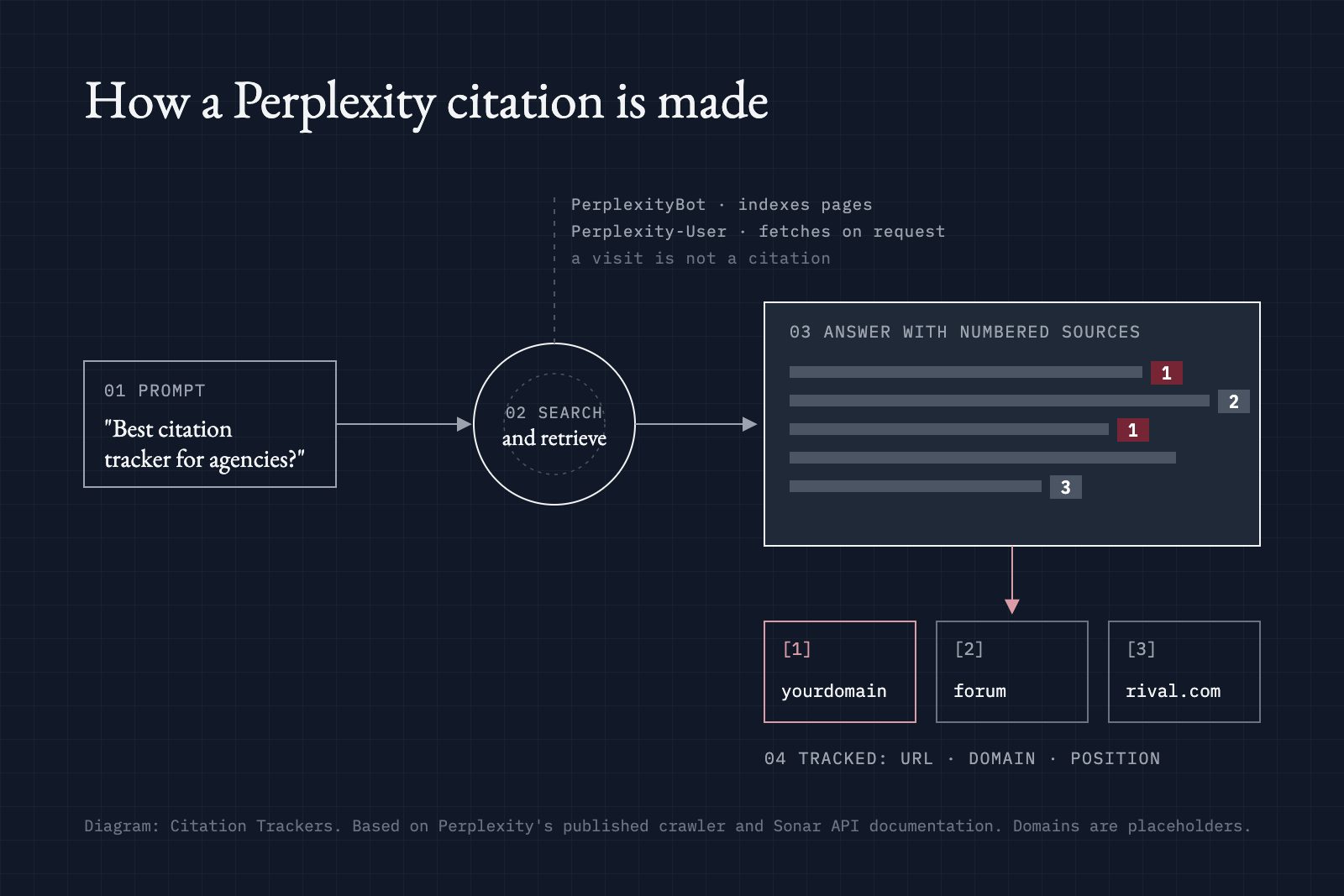
- What Is the Difference Between Retrieval and Citation?
- How Does Citation Frequency Per Answer Work?
- Which Metrics Should a Team Report Every Month?
- Frequently asked questions
- References
What Is an AI Citation Metric?
An AI citation metric quantifies how often, how prominently or how extensively an AI-generated answer attributes information to a page or domain. Depending on the tool, the measurement may count answers, citation events, unique URLs, domains, retrieved pages or source-list positions.[1][2]
That distinction matters because one answer can contain several URLs from the same domain, cite the same URL repeatedly, or retrieve a page without displaying it as a citation. A headline “citation rate” can therefore represent answer-level coverage, citation intensity or another vendor-specific calculation.[3]
The first rule is simple: never report a citation percentage without its numerator, denominator and counting unit.
The main measurement layers
- Answer coverage: the percentage of tracked answers that cite a domain at least once.[4][5]
- Citation volume: the number of citation events or cited pages attributed to a domain.[6][1]
- Citation share: the domain’s share of all counted citation events.[2][7]
- Retrieval: whether a page or domain was found or used during answer generation, regardless of whether it appeared in the final answer.[8][9]
- Source position: where a citation appears in an answer’s ordered source list.[10][11]
- Category mix: how citation volume is distributed across source types such as articles, reviews, forums or reference pages.[12]
Which Citation Metrics Should You Track?
The table below uses each vendor’s published terminology where available. “Operational” formulas are transparent calculations for reporting; they are not claims that every platform implements them identically.
| Metric | Definition as published | Formula | What it tells you | Pitfall |
|---|---|---|---|---|
| Citation incidence / coverage | Promptwatch defines citation rate as the percentage of tracked responses that cite a domain at least once.[5] Peec calls the comparable field Cited.[7][11] | Citing answers ÷ all answers × 100 | How broadly the brand appears in relevant answers | “Citation rate” may mean a different metric in another tool |
| Citation share | Peec defines it as the percentage of all citations belonging to a source; Profound applies the concept to domains, pages or citation categories.[13][14] | Domain citation events ÷ all citation events × 100 | How much of the citation pool the brand receives | Repeated citations and deduplication rules vary |
| Citations Share of Voice | Scrunch measures the share of citation-containing responses that cite an owned source.[15][13] | Answers citing owned source ÷ answers containing any citation × 100 | Competitive presence among answers that contain citations | It excludes answers with no citations |
| Retrieved percentage | Peec describes this as the percentage of chats retrieving at least one URL from a domain.[6] | Chats retrieving domain ÷ all chats × 100 | How often the engine finds the domain during processing | Retrieval does not prove final-answer attribution |
| Citation rate, Peec | Peec defines it as the average number of times a domain was explicitly cited when it was used as a source.[6][16] | Domain citations ÷ responses where domain was used as a source | Citation intensity conditional on source use | It is a count per response, not necessarily a percentage |
| Citation frequency per answer | Promptwatch describes citations per response as the average number of sources an answer cites.[9] | Citation events ÷ all answers | How citation-dense the answer set is | Averages can conceal answers with no citations |
| Unique cited URLs | Profound distinguishes a specific cited page from the domain behind it.[13] | Count distinct normalized cited URLs | Which individual pages earn attribution | URL parameters, redirects and fragments can create duplicates |
| Unique cited domains | A domain is the website behind a citation, distinct from a specific cited page.[13] | Count distinct domains under a declared grouping policy | Breadth of publisher or website attribution | Subdomains may be separate or grouped |
| Source-list position | Promptwatch defines citation rank as the position of a cited page in an answer’s source list, starting at 1.[17] | Sum of usable positions ÷ positioned citations | Whether the brand tends to appear early or late in source lists | Some engines do not expose a stable order |
| Citation-share rank | Profound sorts domains or pages by Citation Share.[18] | Sort sources by citation share | Competitive ranking across the dataset | It is not the same as position inside an answer |
| Source-category share | Profound supports Citation Share by citation category; Peec classifies source types and pages.[13] | Category citations ÷ classified citations × 100 | What kinds of sources AI systems rely on | Taxonomies and multi-label rules differ |
How Do Citation Rate and Citation Share Differ?
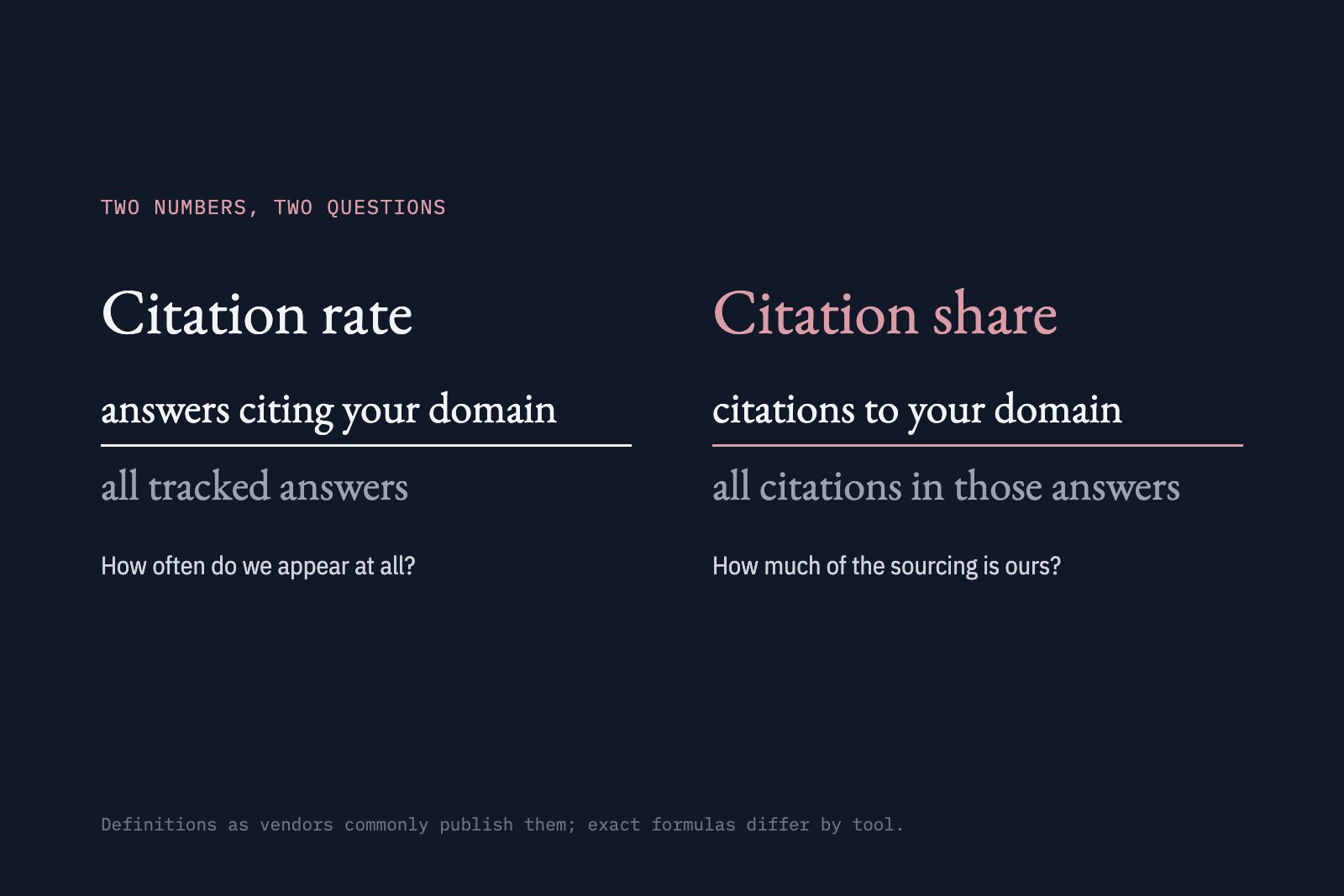
Citation incidence measures breadth; citation share measures volume. If 30 of 100 answers cite a brand, its answer-level coverage is 30%. If those answers contain 60 citations to the brand out of 300 total citation events, its citation share is 20%.[5]
Those values can both be correct because they answer different questions:
- Coverage: In how many answers did the brand appear as a source?
- Share: What proportion of all counted citations went to the brand?
- Intensity: How many times was the brand cited in answers where it was used as a source?
- Frequency: How many citations did the brand receive per answer across the entire panel?
Scrunch makes the denominator issue especially clear. Its Citations Rate includes all responses, including answers with no citations, while Citations Share of Voice uses only answers containing citations.[6][15] A brand can therefore have a 30% all-answer rate and a 37.5% share among citation-containing answers without any contradiction.
Worked example: three valid numbers from one panel
The following is a hypothetical example, not a benchmark.
Assume:
- 100 total answers
- 80 answers contain at least one citation
- 30 answers cite the target domain
- 50 answers retrieve or use the target domain as a source
- 60 citation events point to the target domain
- 300 citation events appear overall
The calculations are:
- Citation incidence: 30 100 × 100 = 30%
- Citation share: 60 300 × 100 = 20%
- Citation Share of Voice: 30 80 × 100 = 37.5%
- Peec-style citation rate: 60 50 = 1.2 citations per source-used answer
- Target-domain frequency across all answers: 60 100 = 0.6 citations per answer
- Frequency among citing answers: 60 30 = 2 citations per citing answer
The percentages are not interchangeable, and 1.2 is not “1.2%”. A team dashboard should display the denominator beside every percentage and the unit beside every average.[19]
Why Do Vendors Report Different Citation Rates?
Two tools can process the same brand and still produce different values because they may not observe the same answer population or count the same objects.
Prompt set and intent
Branded prompts often produce different citation patterns from non-branded category prompts. Promptwatch notes that pricing and brand-specific prompts tend to self-cite more heavily, while category prompts more often cite third-party sources.[20]
A tool tracking 100 branded prompts is not directly comparable with one tracking 100 non-branded questions. Align topics, funnel stages, branded versus non-branded wording and prompt weighting before comparing rates.[9][21]
Engines, models and interfaces
Different engines expose different source formats and source-list lengths. Promptwatch recommends calculating cited-URL rates per engine, while Semrush documents engine-specific position rules for ChatGPT, Google AI Mode and Gemini.[9][22]
The collection interface also matters. A consumer-facing search experience, an API call and a vendor’s own monitoring interface may return different citations even when the wording is identical. Record the engine, model, search mode and collection interface.
Sampling cadence and repeated runs
AI answers can vary between repeated runs of the same prompt. The academic GEO study found source overlap across repeated measurements in the range of roughly 0.32–0.43 in its campaigns and recommended at least seven runs for brand monitoring and eight for source coverage under its study design.[3]
Those numbers are conditional, not a universal minimum. The study used a finite reference set and a particular error criterion, so teams should disclose repetitions rather than treating seven or eight as a guarantee.[23]
Location and language
Region and language can change both the answer and the available sources. Profound defines region as the country to which a prompt is scoped, and Otterly exposes engine and country filters.[13]
A citation rate measured in the United States may not match one measured in Germany, even with the same prompt text. Keep country, language and location settings fixed during a reporting period.
Denominator choice
One tool may divide by all answers, another by answers containing citations, and another by answers in which the domain was retrieved or used as a source.[1][11]
Always label the denominator explicitly:
- All answers
- Answers containing any citation
- Answers citing the target domain
- Answers retrieving or using the target domain
- All citation events
Citation events versus unique presence
Peec counts repeated inline citations in citation share, while Ahrefs counts a cited page once when it appears at least once in an answer and counts a domain citation when at least one page from that domain is cited.[4][6]
For example, if one answer cites example.com/a twice and example.com/b once:
- Inline-event counting produces three citations
- Unique-page counting produces two cited pages
- Unique-domain presence produces one domain citation
All three are defensible measurements if the rule is disclosed.
Are Cited URLs and Cited Domains the Same Metric?
No. A cited URL identifies a specific page; a cited domain identifies the website behind it.[19]
Suppose an answer cites:
example.com/guideexample.com/researchotherexample.org/report
That is three cited URLs and two hostnames. A root-domain report may show two domains, while a page report shows three URLs.
The reporting level should match the decision:
- Use URLs to identify pages that need updating or promotion.
- Use domains to compare publishers, competitors and source owners.
- Use root domains for broad brand-level reporting.
- Preserve subdomains when documentation, support or regional sites are strategically distinct.
Promptwatch lists subdomains separately and applies different subdomain rules to different metrics, illustrating why domain scope must be documented rather than assumed.[19][24]
How Should You Normalize Citation URLs?
URL normalization should reduce technical duplicates without erasing meaningful page distinctions.
Promptwatch recommends removing tracking parameters and resolving common URL variants before counting pages. MentionsAPI’s documented process removes parameters such as utm_*, gclid and fbclid, resolves redirects and normalizes trailing slashes.[25]
A safe record should retain:
- The raw URL displayed by the engine
- The normalized URL used for counting
- The hostname
- The chosen root-domain or brand group
- The observation date
- The redirect destination, if checked later
Do not automatically delete every query parameter. Topify notes that parameters may select products, languages or documentation versions, so removing all query strings can merge genuinely different pages.[24]
A redirect destination should also not be counted as a second citation. The original URL is the historical observation; the redirect path is a later inspection of where that citation resolves.[24]
What Is Source Position, and How Is It Different From Citation Rank?
“Position” and “rank” can describe at least three different things:
- Source-list position: where a cited page appears inside one answer.
- Citation-share rank: where a source ranks after domains or pages are sorted by citation share across a dataset.
- Brand position: where the brand appears in the answer’s recommendation or mention order.
Promptwatch’s citation rank refers to the position of a page in an answer’s cited-source list.[17][26] Profound’s Citation Rank sorts sources by Citation Share across the dataset.[27][13] These should never be compared as though they were the same metric.
For a source-list average, use:
[ \text{Mean source position} = \frac{\text{sum of usable source positions}} {\text{number of positioned citations}} ]
If four citations appear at positions 1, 2, 3 and 4, the mean is 2.5. An answer without an ordered citation list should not automatically be treated as position zero.
Semrush also documents engine-specific rules: ChatGPT Search, Google AI Mode and Gemini do not necessarily number or place citations in the same way.[28] Include the engine and position convention in every source-position report.
What Is the Difference Between Retrieval and Citation?
Retrieval is discovery; citation is displayed attribution. Ahrefs separates pages cited in the answer from pages found in the background, while Promptwatch distinguishes inline citations, footnotes and uncited search results.[26][6]
A page can therefore be:
- Retrieved and cited
- Retrieved but not cited
- Not visibly retrieved but still displayed as a citation through another process
- Cited in one run and absent in another
Do not combine retrieval and citation into a single unexplained total. Retrieval is useful for diagnosing whether a page enters the engine’s evidence set; citation measures whether the page receives visible attribution. The evidence set can also come from searches you never see: Finseo’s query fan-out study found that AI Mode rewrites one prompt into about nine synthetic searches.
How Does Citation Frequency Per Answer Work?
Citation frequency describes how many citations appear per answer, but the denominator still matters.
If 300 total citation events appear across 100 answers, overall citation frequency is:
[ 300 \div 100 = 3 ]
If the target domain receives 60 of those events, its frequency across all answers is:
[ 60 \div 100 = 0.6 ]
If only 30 answers cite the target domain, its frequency among citing answers is:
[ 60 \div 30 = 2 ]
Peec separately documents an average-citations calculation using responses where content was cited, while its domain citation-rate definition uses responses where the domain was used as a source.[19][6] Preserve those denominators instead of collapsing both fields into “average citations”.
Which Metrics Should a Team Report Every Month?
A useful team scorecard should be compact enough to act on and detailed enough to reproduce.
- Freeze the prompt panel. Record exact prompts, intent, branded status, topic and weighting. Adding prompts during a period can change the result without proving improvement.[28]
- Define the observation population. Record engines, models, interfaces, countries, languages, dates and search modes.[3]
- Repeat measurements. Use multiple runs per prompt and report the number of prompts, answers and repeats. The academic evidence supports repeated measurement and rolling windows rather than one-off snapshots.[3]
- Choose one primary coverage metric. Report citing answers divided by all answers, labelled as citation incidence or coverage.[22]
- Add citation share. Show the numerator, total citation denominator and counting unit—inline events, unique pages or unique domains.[19]
- Report cited URLs and domains separately. Include normalization, subdomain and root-domain rules.[24]
- Add source position only when ordered data exists. State whether it means within-answer source position, citation-share rank or brand position.[9][22]
- Show source-category mix. Keep the taxonomy stable and disclose how unknown or overlapping categories are handled.[24][1]
- Separate retrieval diagnostics. Report retrieved-but-uncited pages separately from visible citations.[9][22]
- Put business outcomes in a separate panel. Include AI referrals, landing pages, leads, conversions and revenue where measurable, while noting that some AI influence produces no click and that AI Overviews traffic may be included in organic traffic.[1][22] Finseo’s AI search attribution research draws on six studies and estimates that analytics records only about 1 in 10 AI-driven conversions, so treat this panel as a lower bound.
Which metrics should be primary?
For most teams:
- Primary: citation incidence or coverage
- Competitive: citation share plus absolute citation volume
- Operational: unique cited URLs and domains
- Diagnostic: source position, retrieval rate and citation frequency
- Strategic: source-category mix
- Business: AI referrals, conversions and revenue, reported separately
A single composite “AI citation score” hides too many choices. A small scorecard with visible denominators is easier to audit, explain and improve.
Why do repeated AI-search runs produce different citations?
AI systems can vary their generated answers and cited sources between runs of the same prompt. The academic GEO study found relatively low source overlap across repeated measurements and recommended repeated runs under its particular design.[28][11] Differences can also arise from index updates, location, model routing, retrieval results and sampling settings. Treat a single answer as an observation, not a stable population estimate.
Frequently asked questions
What is citation rate in AI search?
Citation rate has no single industry-wide definition. Promptwatch defines it as the percentage of tracked AI responses citing a domain, while Peec uses the term for average citations when a domain was used as a source.[6] Always publish the numerator, denominator and unit.
What is citation share in AI search?
Citation share is generally the proportion of counted citation events attributed to a domain, page or category.[1][19] The result depends on whether the tool counts repeated inline citations, unique pages or unique domains.[9]
How do you measure AI citations?
Freeze a prompt panel, collect repeated answers across defined engines and markets, identify visible citations, normalize URLs, group domains under a declared policy and calculate coverage and share separately. Record the collection dates, repetitions and denominator so another analyst can reproduce the result.[19]
What is source position in ChatGPT?
Source position is the location of a citation in an answer’s ordered source list, where position 1 is the first listed source under Promptwatch’s definition.[26] ChatGPT and other engines may expose citations differently, so position should always include the engine and its counting convention.[28]
What is the difference between a cited URL and a cited domain?
A cited URL is a specific page, while a cited domain is the website behind that page.[18][13] Several cited pages can therefore produce multiple URL records but one domain-level record, depending on the grouping rule.
Why do two AI citation tools show different numbers?
They may use different prompts, engines, models, markets, sampling schedules, denominators, citation-event rules, URL-normalization methods or domain-grouping policies.[3][29] The numbers become comparable only after those measurement specifications are aligned.
References
- 1How to build a meaningful AI search visibility dashboard.searchengineland.com
- 2Scrunch Metrics Reference: Explorer Names and API Fields | Scrunch Help Center.helpcenter.scrunchai.com
- 3Don’t Measure Once: Measuring Visibility in AI Search (GEO).arxiv.org
- 4AI Visibility Metrics | Help Center - Ahrefs.help.ahrefs.com
- 5Domains.docs.peec.ai
- 6Metrics Overview.docs.peec.ai
- 7Create an AI Brand Visibility Report [+ Template].semrush.com
- 8How to track your AI citations and sources with Semrush.semrush.com
- 9Prompt tracking methodology to measure AI visibility.semrush.com
- 10Prompt Tracking on Semrush.semrush.com
- 11NEW Research: AIs are highly inconsistent when recommending brands or products; marketers should take care when tracking AI visibility - SparkToro.sparktoro.com
- 12Source types.docs.peec.ai
- 13Glossary - Profound.help.tryprofound.com
- 14Interpret Answer Engine Insights | Profound Help Center.help.tryprofound.com
- 15Understanding Citation Metrics in Scrunch | Scrunch Help Center.helpcenter.scrunchai.com
- 16Understanding your metrics - Peec.ai Docs.docs.peec.ai
- 17Citation Rank - AI Search & GEO Glossary | Promptwatch.promptwatch.com
- 18Cited URL Rate - AI Search & GEO Glossary | Promptwatch.promptwatch.com
- 19AI Citation Share: Audit Syndicated and Duplicate Sources | Topify.topify.ai
- 20Self-citation rate.promptwatch.com
- 21Semrush Features for AI Visibility.semrush.com
- 22How to measure AI search visibility: KPIs & reporting.semrush.com
- 23AI Citation drift: How stable are sources in AI search results? - SISTRIX.sistrix.com
- 24LLM Citation Tracking: Trace Redirects Without Rewriting History | Topify.topify.ai
- 25Citation canonicalization — MentionsAPI Docs.mentionsapi.com
- 26Understanding sources and citations.promptwatch.com
- 27Citation Share node - Profound.docs.tryprofound.com
- 28AI Search Visibility: How Stable Are Brand Mentions and Citations?.otterly.ai
- 29How to Specify a Canonical with rel="canonical" and Other Methods | Google Search Central | Documentation | Google for Developers.developers.google.com